
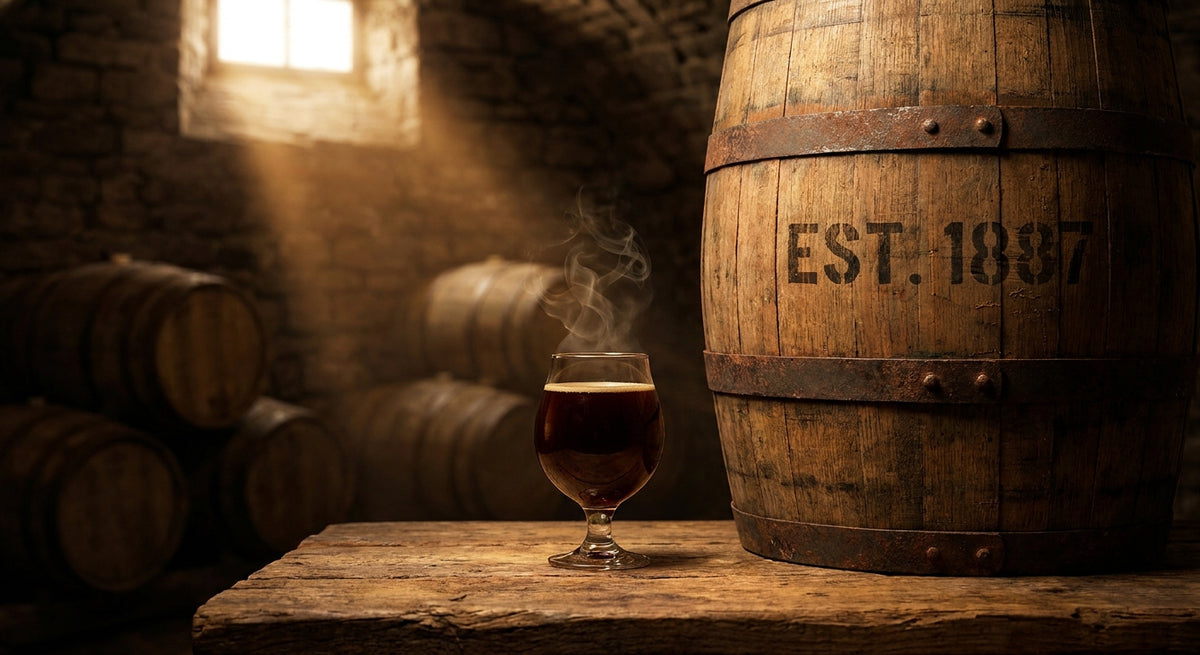
What Makes a Beer 'Barrel Aged'?
Barrel aging is exactly what it sounds like: finished beer goes into wooden barrels, most commonly oak, and sits there for months. Those barrels previously held bourbon, whiskey, wine, rum, brandy, sherry, cognac, or port. During that time, two layers of flavour transfer happen simultaneously. The beer pulls compounds from the wood itself (think vanilla, tannins, caramel, toasted oak) while also absorbing the residual spirit or wine that soaked deep into the staves.
Here's a common misconception worth clearing up: barrel-aged beers aren't high in alcohol because the barrel "spikes" them. The leftover spirit in the wood contributes almost nothing to the final ABV. Brewers intentionally brew these beers strong, typically 10–14%+ ABV, because high alcohol acts as a natural preservative during months of aging.
So why do bourbon barrels dominate? US law requires straight bourbon to be aged in new charred oak barrels. Once used, those barrels flood the market at low cost. Brewers get incredible flavour vessels for a fraction of what specialty barrels cost.
The category traces its roots to the early 1990s in the US. Goose Island's Bourbon County Brand Stout is widely credited as the world's first bourbon barrel-aged imperial stout, and it remains the benchmark more than three decades later.
A Brief History: From Goose Island to a €1.8 Billion Market
Goose Island didn't just create a beer in the early '90s. They created a blueprint. Bourbon County Brand Stout showed the world that beer could absorb the character of a whiskey barrel and become something entirely new. Every brewer working in the barrel-aged space since has followed that template.
Samuel Adams entered the game in 1993 with Triple Bock. That lineage runs directly to the 2025 Utopias, a 30% ABV behemoth experimenting with Irish Whiskey, Amarone, and White Port barrels alongside its traditional Ruby Port, Carcavelos, Cognac, and Scotch casks. Founders KBS (Kentucky Breakfast Stout) has been a flagship for over 20 years, proving this category has staying power, not just hype.
The numbers confirm it. The global barrel-aged beer market was valued at roughly €1.8 billion in 2026 and is projected to reach €2.7 billion by 2034, growing at a CAGR of 6.2%. That growth is remarkable when you consider that overall US craft beer production declined 5.1% in 2025. Barrel-aged and super-premium segments are the resilient outliers.
This is the premiumization paradox at work. Drinkers are buying less beer but spending significantly more per bottle. Super-premium beer hit 40.7% of total beer volume in 2025, up from 39.6% just two years earlier. Barrel-aged craft beer sits right at the centre of that shift. People want fewer, better beers, and they're willing to pay for them.
The Barrel Spectrum: Beyond Bourbon
Bourbon barrels are the classic for good reason. They deliver vanilla, caramel, dark fruit, and toasted oak in a way that complements big stouts beautifully. But the most exciting developments in 2026 are happening with brewers who push far beyond bourbon.
Cognac barrels are gaining serious ground. Goose Island's 2025 lineup included a cognac barrel-aged stout, bringing dried fruit, floral notes, and a refined brandy warmth that bourbon can't replicate.
Rum barrels add tropical sweetness, molasses, and brown sugar. They pair brilliantly with adjunct stouts loaded with chocolate, coffee, or coconut.
Mezcal and tequila barrels represent an adventurous frontier gaining real traction in 2026. Smoky, earthy, agave-forward, these barrels create beers that challenge expectations in the best possible way.
Wine barrels open up another dimension entirely. Red wine barrels layer dark fruit and tannin onto big stouts, while white wine barrels (especially for saisons and sours) bring brightness and acidity that cuts through richness.
Port, sherry, and Scotch whisky barrels round out the spectrum. The Samuel Adams Utopias 2025 uses Ruby Port, Carcavelos, Cognac, and Scotch casks alongside newer Irish Whiskey and White Port additions, showcasing just how far barrel programs can stretch.
If you think barrel-aged beer means "bourbon stout," you're only seeing a fraction of the category. The most exciting releases right now are coming from unexpected wood.
Iconic Releases Worth Knowing (and Hunting Down)
Goose Island Bourbon County Brand Original Stout 2026 (14.2% ABV) remains the benchmark. Aged an average of 13 months in freshly emptied barrels from Buffalo Trace, Heaven Hill, Four Roses, and Wild Turkey, it delivers everything you want from a bourbon barrel stout. The 2026 lineup also includes a Triple Barrel Stout, Toasted Barrel Rye Stout, Triple Oak Barleywine, and the wild-card Proprietor's Stout (Pineapple Upside Down Cake). Yes, pineapple upside down cake. In a barrel-aged stout. It works.
Founders KBS 2025 is the original Kentucky Breakfast Stout, now joined by limited variants KBS Hazelnut Fudge and KBS Iced Latte. These dessert stouts are as Instagram-worthy as they are delicious, and they sell out fast for a reason.
Three Floyds Dark Lord is one of the most sought-after limited releases in American craft beer. Even with distribution across 22 US states, it's nearly impossible to find in Europe without a direct import partner.
American Solera's Nine Lives was named among Beer & Brewing magazine's best beers of 2025. This stout spent 40 months in Heaven Hill wheated bourbon barrels. Forty months. Let that sink in.
Jackie O's bourbon barrel-aged barleywine, a collaboration with Fonta Flora, was another 2025 standout from the same list. It's proof that the barleywine format is having a serious barrel-aged moment.
The Canadian Angle Most Europeans Miss
At the 2025 Canadian Brewing Awards, with over 1,600 beers judged, Gold for Barrel-Aged Beer went to Tatamagouche Brewing Co. for "Lillith," a bourbon barrel-aged imperial porter with vanilla and orange peel. Gold for Barrel-Aged Strong Beer went to Flora Hall Brewing for a Foeder Aged Chocolate Stout. These are award-winning beers that almost no European retailer stocks.
At Beer Republic, we stock a curated selection of barrel-aged releases direct from North American breweries, including beers from many of the names above. Everything is imported cold and stored refrigerated, so what arrives in your hands is exactly what left the brewery. No grey-market detours. No warm shipping containers. The real thing.
How to Cellar Barrel-Aged Beers Like a Pro
Barrel-aged imperial stouts hit their flavour sweet spot between 1 and 3 years of cellaring. Serious collectors hold bottles for a decade or more, watching vanilla and roast mellow into leather, dried fruit, and deep complexity. The transformation is real, and it rewards patience.
Storage basics: keep bottles at 10–14°C (50–57°F) in a cool, dark space. A basement or dedicated beer fridge works perfectly. Avoid temperature swings and direct light at all costs. Store bottles upright (unlike wine) to minimise contact between the beer and the cap, which reduces oxidation risk.
One of the most rewarding trends in the barrel-aged world is the vertical tasting: buying multiple vintages of the same beer and tasting them side by side. Grab a Bourbon County Stout from 2023, 2024, and 2025, pour them together, and track how the beer evolves year over year. It's the sommelier approach applied to craft beer, and it's genuinely fascinating.
Then there's drop culture. Limited annual releases like Bourbon County (Black Friday), KBS (spring), and Dark Lord Day create genuine scarcity. European buyers who can't queue at a Chicago bottle shop need a trusted import partner to access these drops when they land.
If you're new to cellaring, start with a high-ABV bourbon barrel stout at 12% or above. The alcohol acts as a natural preservative and gives the beer the best aging runway.
Why Do Barrel-Aged Beers Cost More? (The Honest Answer)
Time is money. Most barrel-aged beers spend 6 to 24 months in barrel. During that period, the brewery's capital is tied up, tanks are occupied, and staff are monitoring the aging process. That American Solera Nine Lives? It sat for over three years. Three years of patience, space, and investment.
The angel's share. A meaningful percentage of liquid evaporates through the barrel staves during aging. What's lost to evaporation is lost revenue, and that cost is built into every bottle.
Barrel procurement. Even "cheap" used bourbon barrels cost money to source, transport, and store. Specialty barrels from cognac, mezcal, or port producers cost significantly more.
Small batch reality. Barrel-aged beers are produced in limited quantities almost by definition. Lower volume means higher cost per unit. There's no way around it.
For European buyers, add the import equation. Genuine cold-chain shipping from North America, refrigerated storage on arrival, and direct brewery relationships all add cost. But they also guarantee authenticity and freshness that grey-market imports simply cannot match. When we say 100% direct from the brewery, we mean it.
Here's the value reframe: a €25–35 bottle of barrel-aged imperial stout represents 12+ months of craft, rare ingredients, and genuine scarcity. Compare that to a bottle of wine or whisky at the same price point. Exceptional value for what you're getting.
Ready to Explore? Start Here
Barrel-aged beer is the most exciting, collectible, and flavour-complex corner of craft beer. It's also the segment growing fastest even as the broader market contracts. There's never been a better time to get into it.
Beer Republic is Europe's #1 source for genuine American and Canadian craft beer. Everything we sell is purchased 100% direct from the brewery, cold-shipped across the Atlantic, and stored refrigerated at our Breda warehouse. That's the only way to guarantee you're getting the real thing.
Check our weekly new arrivals for barrel-aged drops. Limited releases move fast, and the best bottles don't sit on shelves for long. Building your first cellar or hunting a specific vintage, the barrel-aged world rewards curiosity. Go explore it.
